




Mineclonia
Mineclonia
| Maintainers | ||
|---|---|---|
| Developers | ||
| Platform | Luanti (cross-platform) | |
| Written in | ||
| Latest version | ||
| License | GPLv3+ (code), CC BY-SA 4.0 (media) | |
| ContentDB | ||
| Source code | ||
Mineclonia is a community-made free & open-source Minecraft clone for Luanti. Started as a fork of MineClone 2 (now VoxeLibre) in May 2023[1], it is currently the largest (by download size)[2] Minecraft-like game for Luanti. Right now, Mineclonia is in the beta stage of development.
The player starts out in a procedurally generated open world made out of blocks (cubes, voxels). They can explore the world, dig, and build using almost every available block to create their own structures. Two main gameplay modes are available:
Survival mode, in which the player is confronted by hostile mobs (monsters) and has to stave off hunger, all while slowly progressing through various aspects of the game (mining, farming, etc); and
Creative mode, where the player has unlimited resources to build and play around and doesn’t take damage, just like in any classic sandbox.
Gameplay
Mineclonia does not enforce a fixed sequence of actions. The player is free to decide what to do and when to do it. As was mentioned previously, in Survival mode, the main concerns are hunger and hostile mobs. Exploration is often necessary, since many resources are found underground or in distant areas. The optional end goal of the game, like in Minecraft, is to enter the End dimension and kill the Ender Dragon.
Resources are gathered and turned into tools, equipment, and other items. Mining provides access to ores, which are smelt into materials needed for crafting (e.g. metal ingots). Farming can be set up to produce food and basic supplies over time. Players can use experience points gained by killing mobs or cooking items to repair or enchant their equipment, altering its behavior and/or making it more efficient.
Building is also present throughout the game. Most blocks can be collected and placed to create various structures, a lot of them may be crafted or stonecut into smaller sub-blocks like stairs or slabs for finer texture. Decorative blocks, plants and dyes can be used to change the appearance of builds. Some game mechanics (i.e. summoning the wither or making a beacon pyramid) are only available through such player-made structures.
More technical play is possible through redstone mechanics, which act as a logic circuit system and a loose analogue to real-world electricity. Power components, like buttons and levers, transmit power through redstone dust and deliver it to mechanisms like lamps and pistons. Later stages of in-game progression often feature complex contraptions making use of this system to automate resource gathering and enhance player builds.
History
Warning
This section is unfinished.
In addition to the later events (including ones that lead to the creation of Mineclonia) being fairly fresh in some devs’ memory, they are also ridden with incredibly stupid drama over who gets to add what to a block game. The editors wish good luck to anybody taking up the courage to write about it from a neutral perspective.
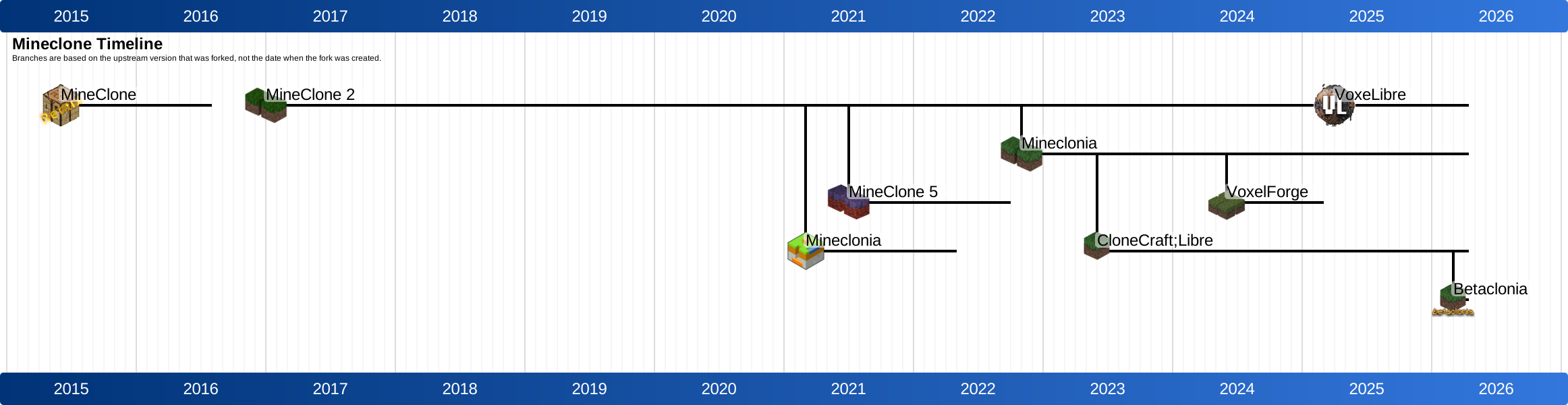
A cladogram depicting the MineClone game family tree to date (click or tap to expand).
Mineclonia is a fork of VoxeLibre (which was known as MineClone 2 at the time of the fork), which was a fork of the original MineClone, which in itself was a fork of Minetest Game circa 0.4. However, there were a lot of things in between these major events, and they are quite complex as well and deserve a proper documentation.
2014-2016: davedevils’ MineClone
Dave Devil’s (aka davedevils) presented the first game of the MineClone series to the Luanti Forums, first as part of his personal server on October 25th, 2014[3], and as a standalone game on March 12th, 2015[4]. The name was an obvious portmanteau of Minecraft and clone. It was yet another mod soup based on the version of Minetest Game vendored with Luanti at the time, featuring Dave’s own recreations of MC content, as well as some popular MTG mods of the era, all (re)textured using Vattic’s Faithful 32 resource pack (a decision that would prove legally problematic in the future).
MineClone was criticized for (expectedly) buggy gameplay and overall hastiness even by that day’s Luanti standards. It also wasn’t the only project of its kind at the time, far from it; in fact, it wasn’t the only one to use Vattic’s Faithful 32 textures[5]. Yet by sheer luck and will of all those who continued his work, Dave’s game is the root of the MineClone game family. Today it can be regarded as a historical explanation for some of the worse internal design choices of Mineclonia and VoxeLibre.
On December 29th, 2016, Dave announced he would halt the development of the project until better times, citing dissatisfaction with Luanti (classic)[6]. Shortly afterwards, on January 5th, 2017, Wuzzy would join the MineClone forum thread, admiring Dave’s work and asking a few copyright questions[7]; they would then go on to announce their own continuation of MineClone very expectedly titled MineClone 2 in a few days.
An archive of the MineClone source code can be viewed on davedevils’ GitHub.
2017-2021: Wuzzy’s MineClone 2
On January 13th, 2017, Wuzzy announced their continuation fork of davedevils’ MineClone via a new thread on the Luanti Forums[8].
The period of Wuzzy’s maintainership would be marked with significant progress happening in the project. Most of the developers that would go on to shape VoxeLibre and Mineclonia have joined Wuzzy in developing MineClone 2 during this era.
Wuzzy would announce their resignation on January 2nd, 2021, explaining it by being burnt out and losing interest in the development of a Minecraft clone[9].
2021-2022: Interregnum (Lizzy Fleckenstein & kay27)
Following Wuzzy’s resignation and some deliberations on the MineClone 2 issue tracker[10], control over the MeseHub repo was transfered to a new organization (as opposed to a single person like before) on January 30th, 2021, with its ownership shared between kay27 and Lizzy Fleckenstein[11].
2022-2023: The Hamburger Troubles
On February 11th, 2022, Lizzy Fleckenstein had resigned and delegated their maintainership over to cora[12].
On November 29th, 2022, cora announced her resignation on the issue tracker[13].
2023-present
On May 30th, 2023, ryvnf created the Luanti Forums thread for Mineclonia[1], finalizing the fork.